How to Save for a Car as a Teenager: A Plan She’ll Stick To
Last Updated on August 11, 2026 by Yadira Bacelic
This post may contain affiliate links, which means I’ll receive a commission if you purchase through my links at no extra cost to you. Please read the full disclosure for more information.

I remember thinking a car was something only “other kids” got. In my head, it meant you had made it. Freedom, independence, all of it. But here’s what I didn’t realize back then: it wasn’t about luck or having money handed to you. It was about having a plan. And once I finally understood that, everything changed.
Knowing how to save for a car as a teenager isn’t about luck or a big paycheck. It’s a number, a date, and a plan she doesn’t quit on somewhere around month four.
Buying a first car is one of the biggest milestones in a teen’s life and one of the most expensive! Did you know the average used car in the U.S. now lists for just over $27,000? That’s a huge number for teens just learning how to manage money. But here’s the good news: with the right
In this guide, we’ll break down the eight essential steps to creating a practical teen car
How can a teenager save for a car?
Set the number first most reliable used first cars run $5,000 to $8,000 then divide it by the months until she needs it. Automate a fixed amount from every paycheck into a separate
That’s the whole plan on one line. Here’s why it works.
Saving for a car can feel overwhelming at first, especially when you’re just starting to earn money.
When I first thought about it, the number felt way too big to even take seriously. But once you stop focusing on the full price and start looking at smaller steps, it becomes a lot more doable.
Creating a teen car
Many teens start by setting aside a portion of their income from summer jobs, part-time work, or small online opportunities. Tracking progress and setting clear
Step 1 – Why Every Teen Needs a Car Savings Plan
I’ll be real with you, I did not have a plan to save for a car when I was a teen. Honestly, I didn’t even think I was capable of getting one. Growing up poor, a car felt like this luxury only “other kids” could have. To me, getting a car at such a young age basically meant you had made it in life. My father didn’t have extra funds to help me save, so for a long time, I just assumed it was out of reach.
It took me years to realize that wasn’t true. Once I finally sat down and started
I remember in high school, some of my friends would work after school almost every single day, fast food jobs, babysitting, retail shifts, and they saved every dollar they could. By the time senior year rolled around, a few of them had enough to pay in cash for their very first cars. It wasn’t flashy, but it was freedom. Watching them taught me something: a car
Why I’d rather she pay cash than carry a payment
Here’s the thing: I’ll be honest with you, I don’t love car loans. As an adult, I did take out a car loan once when I bought a car, but I hated every minute of making those payments. I worked hard and paid it off quickly, but I promised myself I wouldn’t do it again. For my next car, I saved. It took a long time, but I bought it in cash. And since then, I’ve only paid in cash for used cars that are in great condition.
The pretend car payment I still use
My system is simple: I act like I have a car payment and put that money into
What she’s really learning here
Now, let’s talk about why this matters for teens. When they skip the car
But here’s the part I love most: independence. There’s just something different about driving a car you actually saved for. It’s not handed to you, and it’s not borrowed. You earned it. When teens take ownership of their own
And here’s the bigger picture: saving for a car connects short-term goals with long-term financial habits. Buying a car feels like a finish line, but really it’s a practice run for life. Teens who learn how to save for a car are the same teens who will know how to save for an apartment deposit, or even a future emergency fund.
That’s why I always say a teen car
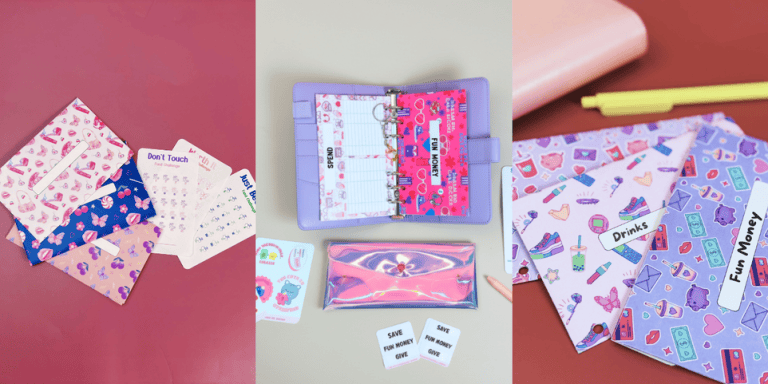
So if you’re a parent or a teen reading this, don’t skip this step. Even starting with a simple envelope labeled “Car Fund” or using a teen budget binder can make a huge difference. It’s not just about the car, it’s about learning financial responsibility in a way that sticks.
Step 2 – Setting a Realistic Car Savings Goal
When I first sat down to plan for a car, I had no idea what a realistic goal even looked like. I’d heard that the average used car in the U.S. was over $26,000, and that number alone almost made me give up before I started.
What a first car actually costs
But here’s the truth: teens don’t need a car that costs anywhere near that much. Most first cars are much simpler and more affordable, often in the $5,000–$10,000 range, and if you’re patient, you can even find a reliable one for less.
The key is to start by researching prices in your own area. Look at Kelley Blue Book, Facebook Marketplace, or local dealer listings to see what cars are actually selling for. Then, factor in the hidden costs: registration, insurance, maintenance, and gas. Trust me, those costs hit just as hard as the car itself.
I learned that lesson fast with my very first repair. My brakes went out, and it cost me $300 just to fix the front ones. To replace all four would have been $700, but I didn’t have enough saved at the time. So I did the front, then saved again to do the back later.
The costs that never make it into the goal
That experience was frustrating, but it taught me an important lesson: your car
Turning the goal into a weekly number
Once you’ve got your target number, the next step is breaking it down into a timeline. Let’s say you’re aiming for a $6,000 first car budget. If you want to buy in a year, that’s about $500 per month. Two years? Around $250 per month. Suddenly, the giant number becomes bite-sized goals that feel possible.
This is where I used my favorite strategy: the pretend car payment. Even before I had a car, I acted like I did. Every payday, I’d move a set amount into
Teens can make this fun by using tools like a teen budget tracker, printable
At the end of the day, setting a realistic
✨ Want a shortcut? I created a free Teen Budget Tracker that breaks down your car
Step 3 – How Much Should a Teen Actually Save for a First Car?
Here’s the number nobody gives you straight: skip the $27,000 average; a solid first car in 2026 usually lands between $5,000 and $10,000, and patient shoppers find reliable ones for less. Aim for your car budget plus about $1,000 extra for the not-if-but-when repairs (ask me about my $300 brakes). Saving $50 a week gets you to $2,600 in a year; $100 a week gets you past $5,000. Pick the timeline that fits her job, set the pretend car payment, and let consistency do the heavy lifting.
How much should she save at 15, 16, and 17?
Knowing how to save and how long to save is what she needs to know. Car payment has become the norm in order to afford a car, which isn’t true. But instead of making a payment to a creditor, she can make it to herself and figure out what is the number or amount she wants to spend on a car. She needs to do her research on what car she wants and what’s realistic and reasonable.
The goal doesn’t really change between fifteen and seventeen. A first car is a first car, and the number she’s aiming at is about the same either way. What changes is how much of that number has to happen each week. A girl who starts at fifteen has almost three years to get there. A seventeen-year-old is trying to reach the same number by spring. Same goal, completely different week.
That’s the part I wish someone had worked out with me instead of just telling me to save more. It was never really about how much I could earn. It was about how many months I had left, and whether anyone was going to sit down and do that math with me while I still had them.
So this part is a conversation, not an assignment. Work it out together what the car actually costs, how many weeks are left, and what those two numbers make her weekly amount. A number she worked out herself is one she’ll defend. A number handed to her is just another rule.
Here’s what it actually looks like at each age:
Saving for a car at 15
Fifteen is the best position she will ever be in, and it’s the one that feels the worst. She can’t drive yet, the car isn’t real to her, none of her friends are talking about it, and putting money in an account for something that far away feels pointless.
But look at what the extra time does. At $40 a week babysitting, a birthday here and there, and no real job, she has about $4,200 by her seventeenth birthday and about $6,200 by her eighteenth. She never needs a big paycheck. She needs someone to sit down and show her at fifteen that $40 a week is a car, because at fifteen, nobody believes that on their own.
If she’s fifteen, this is the year to open the separate account and agree on the number together. That’s the whole first step. The saving is the easy part when you have this much time.
Saving for a car at 16
Sixteen is the most common age to start and the tightest math in this entire post. She has her license or she’s weeks away from it, the car is suddenly extremely real, and she wants it now. Twelve months is a realistic window. Ten is more common.
At twelve months, a $6,000 car means $115 a week. That’s a real part-time job not babysitting, not birthday money. Fifteen hours a week at $12 an hour is about $180 before taxes, so she’d be putting away roughly two-thirds of everything she earns. It’s possible. It is not comfortable.
This is the age where a match earns its keep. If you can put in fifty cents on her dollar up to a cap you say out loud in month one, her $75 a week becomes $112 and the timeline stops being punishing. She still did the work. She’s just no longer racing a clock that was never fair to begin with.
Saving for a car at 17
Seventeen has the least time, and it’s the only one of the three where the honest conversation has to happen in month one instead of month eight.
Six to ten months at $100 a week is $2,600 to $4,300. That’s a real car. It’s just not the car she has in her head. So there are three levers and she gets to pick: earn more, spend less on the car, or move the date. Picking one in month one feels like a small loss. Finding out in month eight that the number was never going to get there feels like failing, and that’s the version that makes her quit.
I’d rather she buy a $3,500 car she owns outright at seventeen than a $9,000 car with a payment attached at eighteen. The first one teaches her something. The second one teaches her she can have things now if she signs for them.
| If she’s | Time she has left | To reach $4,000 | To reach $6,000 |
|---|---|---|---|
| 15 | About 30 months | $31 a week | $46 a week |
| 16 | About 12 months | $77 a week | $115 a week |
| 17 | About 8 months | $115 a week | $173 a week |
Weekly amount needed to reach a $4,000 or $6,000 car fund, by the age she starts.
The weekly number in the last two columns is what decides whether she gets there. If it’s bigger than what she can realistically earn in a week, the date moves. Not the plan.
Use the table with her, not at her. Let her pick which target column she’s aiming at; that one choice is what turns this from a rule into her plan.
Step 4 – How Teens Can Earn Money for a Car
After setting my first real car
Steady jobs that actually fund a car
Some of my friends in high school worked almost every single day after school, fast food shifts, grocery store stocking, and babysitting on the weekends. I’ll never forget one friend who saved all year long and walked into a dealership senior year to pay cash for her first used car.
Watching her was proof that consistency, not a huge paycheck, was what really made the difference. Meanwhile, I was doing odd jobs here and there, and my
The friend who sold jewelry at the markets
I also had a friend who started selling jewelry she made by hand. She would set up a little booth at markets with her mom on weekends, and every dollar she made went straight into her car
Honestly, the joy on her face when she drove that car was better than if she’d gotten something fancy. That moment stuck with me: you don’t need a perfect car to feel proud, you just need one that you earned yourself.
Traditional jobs like babysitting, tutoring, or retail might not sound exciting, but they’re steady.
When I finally got consistent hours, I could actually stick to my “pretend car payment” strategy and set aside the same amount every week. Having a predictable paycheck helped me stop treating
But not every job has to be traditional. My jewelry-selling friend proved that creative side hustles can be just as effective. And these days, teens have even more opportunities with things like Etsy shops, digital downloads, or managing social media for local businesses. Even if it’s not steady, those little projects can pile up fast when you funnel the money straight into a car fund.
Seasonal work, and what a parent match does to the timeline
Seasonal jobs were another game-changer for me. One summer, I worked long hours, almost nonstop, and by the end of those three months, I had saved more than I had the entire school year before. If teens commit to pushing most of that seasonal income toward their car
Some parents even use a matching system, where for every dollar the teen saves, the parents match. My dad wasn’t able to do that, but I’ve seen families where it worked like magic. Imagine saving $2,000 and suddenly having $4,000 to work with. That kind of boost turns a small beater car budget into something safe and reliable.
The main thing I learned? It doesn’t matter if the money comes from babysitting, jewelry-making, retail, or mowing lawns; what matters is consistency. Every dollar I earned had a job, and that job was to bring me closer to the driver’s seat.
And when you watch your total inch closer to that car goal $500, $1,000, $2,000, it lights a fire under you to keep going. That’s when the
Step 5 – Smart Saving Strategies for Teens
So once the money starts coming in, the next question is: what do you actually do with it? I’ll be honest, when I first started earning, I was terrible at hanging onto my cash. Babysitting money would vanish at the gas station snack aisle, and my first paycheck from retail felt like it was gone before it even hit my bank account. That’s when I realized earning is one thing, but saving takes a plan of its own.
Now, here’s the truth: I didn’t even have a car in my teens. My father couldn’t help me save, and honestly, I didn’t think I was capable of getting one back then. It wasn’t until I became an adult that I bought my first car. By that point, I had already made a lot of mistakes with money, so when I finally created a car
Open the account she can’t spend from
The very first smart move I made was opening a savings account just for my car fund. I didn’t think much about interest at the time, but even just having it separate kept me from “accidentally” spending it. That separation is huge for teens, too. It’s way too easy to let money drift into fast food or impulse buys if it’s all in one pile.
The second strategy, and honestly, my favorite, is the pretend car payment method. Even before I had enough money for a car, I acted like I already had a loan. Every payday, I moved that “payment” into
Give every dollar a job before it lands
When I finally had enough to buy my car outright, the habit was already there. I don’t personally believe in the 50/30/20 rule that a lot of people talk about. To me, it feels too broad and kind of vague. Instead, I use a zero-based budget; every single dollar gets a job before it even hits my hands. If I earn $300 from work, I’ll literally map out: $200 goes into the car fund, $50 for gas, $25 for fun, $25 for
The maintenance fund I learned about the hard way
Teens can do the same thing even if their income is small, assigning every dollar gives them way more control. And then there’s the maintenance lesson I learned the hard way. My very first car repair was brakes $300 for the front, $700 for all four. I could only afford to fix the front right away, and then I had to save again for the back. That moment taught me to split my
For teens today, I’d say make saving visual and fun. Use a budget binder with envelopes labeled “Car Fund” and “Repairs.” Print out a tracker where you color in a car or gas gauge as you hit milestones. Or use apps like Greenlight or GoHenry to automate the process. Watching progress build even slowly keeps you motivated.
The biggest shift for me came when I stopped waiting for “extra money” to save and instead treated saving like a non-negotiable. Once I did that, my car fund grew steadily. And even though I didn’t have a car in my teens, I know these same strategies would have gotten me there faster if I had started earlier.
What Her Weekly Amount Turns Into Over Time
| If she saves | In 1 year | In 2 years | In 3 years |
|---|---|---|---|
| $25 a week | $1,300 | $2,600 | $3,900 |
| $50 a week | $2,600 | $5,200 | $7,800 |
| $75 a week | $3,900 | $7,800 | $11,700 |
| $100 a week | $5,200 | $10,400 | $15,600 |
The same weekly habit, stretched over one, two, and three years.
Step 5 – Budgeting Tools and Trackers for Car Savings
When I finally decided to save for my first car as an adult, I realized really quickly that a budget on paper wasn’t enough. I needed actual tools to help me stay on track. Otherwise, I’d make a plan, forget about it, and suddenly my “car fund” would get eaten by fast food runs or impulse Target trips. Having the right trackers and systems was the difference between me wishing for a car and actually driving one.
Printables and binders
The first thing that helped me was a printable car
I also love using budget binders. With a zero-based budget, every dollar has a job, and a binder makes it easier to separate those jobs. I had envelopes for “Car Fund,” “Repairs,” “Gas,” and “Insurance.” If I made $100, I’d divide it across the envelopes according to my plan. It sounds old-school, but it worked. Physically tucking money into the right spot kept me honest. Teens can do the same, and honestly, it feels kind of satisfying to watch those envelopes fill up.
Apps she’ll actually open
Digital tools are great too. There are apps made for teen
Two trackers, not one
One thing I recommend is having two separate trackers, one for the purchase price of the car and one for ongoing costs like repairs and insurance. I learned this the hard way when my brakes cost $300 for the front and $700 for all four. If I’d only tracked the “car purchase” and ignored maintenance, I would’ve felt like I failed once the repair bill came. Splitting them into two trackers shows the full picture and keeps you prepared.
It only works if she can see it
And here’s a little bonus trick: make your tracker visible. Don’t shove it in a drawer. Stick it on the fridge, hang it above your desk, or keep it in your binder where you see it every day. That constant reminder helped me stay focused, especially on days when I felt tempted to spend instead of save.
At the end of the day, the best tool is the one you’ll actually use. Some people thrive on spreadsheets, others like apps, and some prefer the envelope method. For me, it was a mix of paper trackers for motivation and binders for cash flow. For teens, the key is finding a system that makes saving less of a chore and more of a challenge. Because once the tools are in place, the car
✨Many of the tools in my money management gifts for teens guide double as car-fund helpers.
Step 6 – Teaching Teens About Car Ownership Costs
When I was saving for my first car, I thought once I had the money for the car itself, I was good. Oh boy, was I wrong. What nobody really told me is that the price tag on the car is just the beginning. Insurance, gas, maintenance, all those little (and not so little) extras can add up just as quickly as the car itself.
The repairs that caught me off guard
My first big wake-up call came with the brakes. I still remember sitting in the mechanic’s waiting room when they told me it would be $300 just to fix the front brakes and $700 if I wanted to replace all four. My stomach dropped. I only had enough saved for the front, so that’s all I could do at the time. I had to limp along and then save up again to do the back later. That experience taught me fast that if you don’t build a maintenance fund into your car
And just when I thought I had learned my lesson, another curveball hit. One summer, my sunroof stopped working, and of course, it was raining. I couldn’t get it to close. I pulled into a nearby parking lot, and thank God I happened to have some plastic wrap with me from moving things. I had to hold it over the roof with one hand while driving, because I didn’t even have tape on me.
Not my proudest moment. Later, the shop told me it would cost $350 just to replace the part and shut it permanently. If I wanted the whole sunroof system replaced, it was going to be $1,200. Yeah, no thanks. I chose the cheaper option and have lived without a sunroof ever since. Lesson learned: cars will always find new ways to test your wallet.
Tires were another hit I wasn’t fully ready for. Mine wore out faster than I expected, and replacing them wasn’t cheap. I remember thinking, I just bought this car, how am I already spending hundreds more? That was the moment I realized car costs don’t spread themselves out nicely; they can pile up all at once. If you don’t have a little extra tucked away, you’ll be stuck stressing instead of fixing.
Insurance, gas, and the bills that come every month
Insurance can be another shock. Adding a teen driver can double or even triple the family premium. And let’s not forget gas and oil changes, which feel small until you add them up over months and years.
A separate envelope for each cost
This is why I started treating car ownership like an ongoing
The car she picks changes what it costs to keep
Another smart move is to think about the type of car you’re buying, not just the price. A sedan might be cheaper on insurance and gas compared to a truck or SUV. A hybrid might cost more upfront, but could save hundreds in fuel over the years. These little differences add up and can make or break your budget.
Looking back, I’m actually glad those brake, sunroof, and tire fiascos happened early on, because they forced me to build a habit I still use today. Every time I save for a car, I also save for the cost of keeping it running. I don’t want my future self stuck choosing between fixing the car and paying other bills. And that’s a lesson every teen needs to hear: buying the car is only half the story. Owning it, maintaining it, and keeping it safe is where the real financial responsibility comes in.

Step 7 – Tips for Parents Supporting Teen Car Savings
If there’s one thing I’ve learned, it’s that teens don’t just need money advice; they need encouragement. When I was younger, I didn’t have anyone guiding me through saving for a car. My dad didn’t have the funds to help, and honestly, I thought getting a car as a teen was impossible. That’s why I feel so strongly that parents can play a huge role in shaping their teens’ car
The weekly check-in at the dinner table
One of the best things a parent can do is set up family money meetings. They don’t have to be stiff or boring, just a weekly check-in around the dinner table. Ask your teen: “How much did you save this week? What’s your goal for next week?” That small accountability builds habits. I’ve seen teens light up when their parents celebrate even a $20 addition to their car fund. It’s not about the amount, it’s about the momentum.
Encourage, don’t control
Another tip? Encourage, don’t control. I’ve noticed that when parents try to run the
If you match, say the cap out loud
If parents do have a little extra to contribute, a matching system can be powerful. For example, match dollar-for-dollar up to a certain amount. I didn’t have that growing up, but I’ve seen how motivating it is for teens. When they realize every $100 they save turns into $200, it pushes them to work harder. Even if parents can’t match financially, offering non-cash rewards like extra driving practice hours or more independence can work too.
Doing the research together
Helping with the research phase is another big win. Teens don’t always know how to check the real cost of ownership, insurance, maintenance, and fuel efficiency. Parents can sit down together and compare different cars online, showing them how a $6,000 car might end up cheaper to own than a $4,000 gas guzzler. That’s a lesson that sticks far beyond the first car purchase.
And when it comes time to actually buy, don’t underestimate the value of support at the dealership or private sale. Teens don’t usually know how to negotiate, ask about warranties, or spot red flags. Even just standing beside them gives them confidence.
At the end of the day, the goal isn’t just to get your teen a car; it’s to help them build money management skills that last. Whether it’s cheering them on when they add $5 to their car fund, showing them how to compare insurance quotes, or reminding them that slow progress is still progress, your influence matters. I know if I’d had that kind of guidance, I probably would’ve started saving earlier and made fewer mistakes along the way.
Step 8 – Preparing for the Big Purchase
After months, or honestly, sometimes years of saving, there comes that exciting (and nerve-wracking) moment: actually buying the car. I remember when I had finally built up enough in my car fund, my heart was racing. Part of me wanted to just hand over the money and drive away, but another part of me knew I needed to slow down and be smart. That last step can make the difference between buying a car you love and buying one you regret.
Why I buy used and keep it five years
The first thing I learned was how important it is to shop smart. When I was younger, I used to daydream about having a shiny, new car with all the bells and whistles. But when I saw the actual price tag and how fast new cars lose value, I knew it wasn’t for me. I stuck to used cars in good condition, and it’s a decision I’ve never regretted. To this day, I’ve only paid cash for used cars, and I keep them for at least five years while saving for the next one. That habit alone has saved me thousands.
Walking away is the negotiation
Next came the part I dreaded: negotiating. I don’t naturally like confrontation, so the thought of haggling over price gave me anxiety. But I realized something most sellers expect you to negotiate. Doing a little homework on Kelley Blue Book values gave me confidence to counter offers and ask for a fair deal. One time, I even walked away from a car I really liked because the seller wouldn’t budge. It felt hard in the moment, but later I found a better deal, and I was so glad I didn’t cave. Teens should know that “no” is a powerful word when it comes to car buying.
The test drive, the inspection, the second opinion
Another step I won’t skip is inspection and test-driving. Even a short test drive can tell you a lot—how the car feels, if it makes strange noises, or if something doesn’t sit right. Getting a second opinion from someone who knows cars, like a parent, a trusted friend, or a mechanic, can give you peace of mind. Even if you don’t end up finding anything wrong, that extra set of eyes makes you more confident in the purchase.
The day she pays cash
Finally, there’s the moment of closing the deal. I can still remember sliding that envelope of cash across the table for my first car. It felt surreal. Nerve-wracking, yes, but also empowering. Because I knew I had worked for it, planned for it, and paid for it without debt. That sense of ownership is something no car loan can give you.
Looking back, preparing for the big purchase was just as important as the saving journey itself. It’s where all the lessons,
Final Thoughts
Looking back, I realize that creating a teen car
The truth is, the car is just the reward at the end of the journey. The real value comes from the lessons along the way: learning discipline, setting realistic goals, finding creative ways to earn, and sticking to a zero-based budget that gives every dollar a job. Those skills don’t stop with a car; they’re the same ones that prepare you for college, an apartment deposit, or even a future emergency fund.
For parents, your role isn’t to do it for your teen, it’s to cheer them on, guide them when they stumble, and celebrate the wins along the way. For teens, the message is simple: it might feel impossible at first, but every $10, every after-school shift, every envelope filled gets you closer to that driver’s seat. And trust me, nothing compares to the feeling of handing over cash for a car you earned yourself.
So if you’re just starting out, don’t overthink it. Begin with a tracker, set your first mini-goal, and commit to saving consistently. Before you know it, you’ll not only have the keys to your first car, you’ll have confidence in your ability to set a big goal and crush it.
👉 To make it easier, download my free Teen Budget Tracker and start coloring in your progress today. Small steps lead to big wins, and your car
Other Posts You May
Teen Emergency Fund: Why Every Teen Needs One and How Parents Can Help Build It
Teen Banking Basics: A Parent’s Guide to Raising Confident Money-Smart Teens
9 Teen Summer Job Money Tips to Avoid Costly Mistakes and Build Healthy Money Habits for Life