Back to School Budget Supplies Every Teen Girl Actually Wants (2026)
Last Updated on July 15, 2026 by Yadira Bacelic
This post may contain affiliate links, which means I’ll receive a commission if you purchase through my links at no extra cost to you. Please read the full disclosure for more information.
I’m the mom with the coupon app open in the checkout line. I replenish supplies all year when they go on sale, I keep a stockpile at home, and both my teenagers know the rule: we don’t buy it unless we actually need it. So no, I’ve never had a $180 back-to-school receipt and I’ve taught my kids why.
But even with all that training, my daughter still loves adding things to the pile. A cuter notebook. One more highlighter set. And why wouldn’t she? She’s not the one paying.
That’s the gap no school supply list covers. There’s a checklist for binders and pencils, but there’s no checklist for teaching her to manage her own money and that’s the one supply she’ll use every week of the school year and long after it. My daughter starts college this August, and I can tell you the backpacks got replaced every year. The money habits didn’t.
So before you grab the fourth pack of mechanical pencils, add these four back to school budget supplies to her list. They’re affordable, they’re cute enough that she’ll actually use them, and they’re the only thing in her bag still working four years from now.
What budget supplies does a teen girl need for back to school?
A teen girl’s back to school budget supplies come down to four things: a cash envelope system for weekly spending, a simple weekly money split (spend, save, give), one
Why money tools belong on the school supply list?
Think about what the school supply list is actually for. It’s every tool she needs to function independently in a classroom so the teacher isn’t handing out pencils and loose-leaf paper all year.
Now think about what happens with money. In my house it was the senior trip she had to pay toward, uniform fees for basketball and soccer season, the Dunkin run, hanging out after school with friends. She’s handling money every single week of the school year and there’s no tool on any list for that. We hand teenagers more spending decisions than ever and zero equipment to manage them.
And here’s the resistance you might hit, because I did: my daughter thought having a
The difference between a teen who runs out of money by Wednesday and one who makes it to Friday isn’t the amount she started with. It’s whether she has a system she can see. When money is a vague number on a phone, it disappears. When it lives in labeled envelopes with a plan attached, she starts telling herself no which is the entire goal.
There’s one more reason to set this up in the back-to-school window instead of January: the school year has a built-in rhythm. New semester, new schedule, new routines forming anyway. A money habit that starts alongside the first day of school just becomes part of how the year works. That’s why money tools sit at the top of my list of money management gifts for teens they’re the rare supply that compounds.

The 4 budget supplies she’ll actually use
A cash envelope system she’s proud to pull out of her bag
Let’s be honest about why most teen
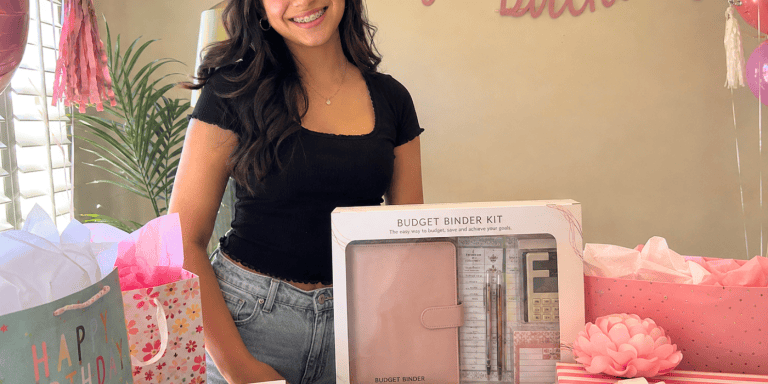
That’s the entire reason I designed the Teen Budget Binder Kit the way I did. It’s handmade, it looks like something she’d pick out herself not a finance product her mom forced on her and it holds labeled envelopes for each job her money has to do. Spending money in one. Uniform fees in another.
The class trip fund where she can watch it grow. And because every kit is made to order, the envelope labels are hers; you pick the categories, the font, and the font color when you order, so the binder shows up already speaking her language instead of some generic templates. The kit also comes with an iridescent pouch, a pen, mini stickers for decorating, and a keychain, everything the habit needs, in one place.
Here’s how it works in practice: at the start of each week or allowance cycle, cash gets divided into the envelopes by purpose. When the “eating out” envelope is empty, eating out is over until it refills no negotiation required, because the envelope already said no. That’s the quiet magic of cash envelopes for teens: the system enforces the boundary so you don’t have to.
And there’s a reason cash specifically works better for beginners than an app. Researchers call it the “pain of paying“study after study shows people spend more with cards than with cash, because handing over physical money registers as spending in a way tapping a phone never does. She feels the envelope get lighter. For a teen just building the habit, that feedback is the teacher.
To be clear, I’m not saying apps are bad. Plenty of teens graduate to one eventually, and that’s fine. But start with cash envelopes until the habit is built. The app can track a habit that already exists; it can’t create one. Cash can.
If she’s brand new to this, start with just three envelopes don’t overwhelm her with twelve categories. My guide to budget envelopes for teen beginners walks through exactly how to start.
A money check-in that takes 5 minutes a week
Nobody, especially not a fifteen-year-old, is logging every purchase in real time. I know because I’ve watched my daughter try: writing down every purchase, every day, lasted about a week before “too time-consuming” won. She wasn’t wrong. The habit that actually sticks is simpler and it runs forward, not backward: before the week starts, she decides where the money goes.
Here’s the whole method. Every Sunday, five minutes, three boxes: spend, save, give. s Whatever came in that week, allowance, babysitting money, birthday cash gets split across the three before a dollar of it leaves her hands. The spend number funds the envelopes. The save number goes toward her goal. The give number is hers to direct a friend’s fundraiser, church, a sibling’s birthday gift.
Why this beats expense tracking for a teen just starting out: logging receipts tells her where money went, after it’s too late to do anything about it. Deciding the split tells her money where to go. And here’s what surprised me in my own house my daughter still knows where her money went, without writing any of it down, because the envelopes do that part for her. Empty eating-out envelope? That’s where it went. The system tracks so she doesn’t have to.
The piece that keeps her showing up every Sunday is the
I made a free teen budget tracker that puts this on one page the spend/save/give boxes at the top, ready to fill in each week. Print a stack, keep them in the front pocket of her budget binder, and Sunday takes care of itself.
One savings goal for the semester (the class trip counts)
Notice I said one. Not a five-year plan, not three competing goals, not “just save in general” one specific thing she wants, with a price tag and a date, reachable by the end of the semester.
This is where most parents overshoot. We want to teach saving as a virtue, so we push vague, adult-sized goals and vague goals are exactly what teens quit. “Save for the future” means nothing at fifteen. “Save $85 by November for the class trip” is a game she can win. The goal doesn’t have to be noble. Concert tickets count. The thing all her friends have counts. What matters is that she picks it, because she won’t protect a goal she didn’t choose.
I’ll tell you how this played out in my house, because it wasn’t instant. My daughter has been working since she was fourteen, so she knew what it meant to earn money that part I never had to teach. What I had to teach was
But starting freshman year, she saved for senior year and when it came, she paid for all of it herself: the senior trip, senior dues, prom dues, the senior activities. My side of the deal was dressing her the prom dress, hair, nails, makeup. She funded the experiences; I funded the sparkle. The system she landed on isn’t purist, either: she runs her checking account, her
Here’s why the goal is the engine of the whole system: the envelopes control this week and the check-in plans it, but the goal is the reason to bother. It’s what makes “no” mean something. Skipping the second Dunkin run stops being deprivation the moment it becomes progress toward the trip same dollar, completely different feeling.
Make the progress visible. A number in an account is invisible, and invisible progress feels like no progress. The same free teen budget tracker from the last section has a color-in
The cute extras that keep her using it
Here’s a truth about teen girls that every mom already knows: the aesthetic is the motivation. If the budget binder is cute and the pens are good, Sunday check-in happens. If it looks like homework, it is homework. So yes the extras matter, and no, they’re not frivolous. They’re the packaging that keeps the habit alive.
The good news: if she has the Teen Budget Binder Kit, most of this is already handled. The kit comes with an iridescent pouch, a pen, mini stickers, and a keychain, which means the pen has a home, the stickers make the binder hers, and everything Sunday needs lives in one place. That’s not an accident. I built the kit that way because the moment she has to hunt for a pen, the check-in dies.
Two small add-ons finish the setup:
Highlighters for the color-in
Sticky notes for the goal. A stack of aesthetic sticky notes for writing the
That’s the whole list. One kit, two add-ons less than the cost of one more backpack keychain, and unlike the keychain, it’s all doing a job.

How to set it up before the first day (a 15-minute Sunday routine)
Don’t turn this into a project. The whole setup is one sit-down, one Sunday before school starts, fifteen minutes and she does it with you, not while you watch. Here’s the exact sequence.
Minutes 1–3: Set the number. Decide together what she’s working with each week allowance, a job paycheck split into weeks, lunch money if she manages it. One number. If it comes in monthly, divide by four so the weekly rhythm still works.
Minutes 4–6: Do the first split. Spend, save, give, she fills in the three boxes on the free teen budget tracker for week one. This is the moment to bite your tongue: she picks the numbers. A split she chose is a split she’ll defend. A split you assigned is a rule she’ll test.
Minutes 7–10: Set up the envelopes. Three to start, no more, whatever her real life actually is. Eating out, going out, and one for whatever she pays toward (uniform fees, club dues, the class trip). The kit comes with personalized labels for the cash envelopes, so this step is mostly peel-and-place then she makes the set hers with the mini stickers, decorating the binder and envelopes until they look like something she picked, not something she was assigned.
Minutes 11–13: Pick the goal. One goal, one price tag, one date reachable by end of semester. She writes it on the tracker’s
Minutes 14–15: Book the standing check-in. Pick the recurring five minutes Sunday evening works because the week’s money is spent and next week’s isn’t. Put it on her phone calendar with an alarm. Not yours. Hers. The habit belongs to the person whose phone reminds her.
That’s the whole install. The first Sunday of the school year, the routine runs itself: split the money, fill the envelopes, color the grid if she saved, done before her toast is cold.
Back to School Budget Supplies That Double as Gifts
Here’s what makes money tools different from every other back-to-school purchase: they’re the rare school supply that works as a gift. Nobody wraps a package of loose-leaf paper. But a personalized budget binder in her favorite colors? That’s a real present one that says “I think you’re ready for this” instead of “here’s more stuff.”
That makes this category perfect for the gift-givers who are always asking what she needs. If grandma wants to send something for the new school year, this beats another gift card she’ll burn through in a weekend it’s the tool that makes every future gift card last longer. And because the Teen Budget Binder Kit is made to order with her categories, font, and colors, it arrives feeling chosen, not generic. Add a little starter cash tucked into the first envelope and you’ve got the rare gift that’s both the thing and the lesson.
A few ways to match the gift to the girl:
Just starting out (middle school and early high school): the Teen Budget Binder Kit plus the free teen budget tracker printed and tucked inside. Everything from this article, ready on day one.
Heading to college: this is where I’ll mention my Cash Envelope Budget Binder the step-up version I designed for girls 18 and up. Same envelope method she learned in high school, scaled for a girl managing real bills instead of lunch money: six cash envelopes, a calculator, a pen, and a pom pom keychain with a letter charm matched to the name on her personalized binder. My own daughter starts college this August; this is the version that goes with her.
The girl who has everything: skip the object, gift the goal. Fund the first few squares of her
If you’re shopping for a teen who loves this kind of thing, my full guide to money management gifts for teens goes deeper, birthdays, holidays, and graduation included.
Every August, the backpack gets replaced. The pens run out, the binder rips, the pencil pouch goes wherever pencil pouches go. That’s fine that’s what school supplies are.
But somewhere in that pile of things she’ll outgrow, there’s room for the one back to school budget supply she won’t: a simple system for running her own money. Four pieces envelopes with her name on them, a five-minute Sunday check-in, one goal she picked herself, and a few cute extras that keep it feeling like hers. Fifteen minutes to set up, one school year to become a habit, and I can tell you from watching my own daughter pack for college this month a habit that walks out the door with her when the backpacks finally stop.
Add it to the list.
FAQ
How much spending money should a teen get for the school year?
There’s no magic number it depends on what she’s responsible for covering. The better approach: list what she pays for (eating out, activities, her share of fees), set a weekly amount that covers it with a little stretch, and let the envelopes enforce it. The amount matters less than the fact that it’s fixed and she manages it.
What’s the best budgeting method for a teenager?
Cash envelopes plus a weekly check-in. Each week she splits her money three ways — spend, save, give then divides the spending cash into labeled envelopes by purpose. When an envelope is empty, that spending stops. It works because it’s visible, takes five minutes a week, and doesn’t require an app, a spreadsheet, or a parent enforcing it.
Are cash envelopes still worth it when everything is digital?
Yes, especially for beginners. Physical cash registers as spending in a way tapping a phone doesn’t; she feels the envelope get lighter. Apps are fine later, once the habit exists. Start with cash until
What age should a girl start managing her own school spending?
Middle school is the sweet spot around 11 to 13, when she starts having real spending moments without you there. Start small: one envelope, one weekly amount. By high school she can run the full system, and by senior year she can be paying for her own activities. Mine did.
What’s a good back-to-school money gift for a teen girl?
A personalized budget binder kit is the strongest pick it’s cute enough that she’ll actually use it, and it’s a tool, not just more stuff. Pair it with starter cash in the first envelope. For a college-bound girl, step up to a full cash envelope binder with more categories.
Other Posts You May Like
15 Best Money Apps for Teens in 2026: Help Your Teen Build Smart Money Habits
Savings Challenge Cards for Teenagers: 9 Stress-Free Ways to Build Saving Habits That Stick